


The Constitution protects every person on American soil, and current immigration enforcement practices are testing that guarantee.
Imagine the government locking someone up, or removing them from the country, without a meaningful opportunity to contest the action before a neutral decision-maker. That scenario is not a hypothetical from an authoritarian regime. It is a live tension in American immigration enforcement today. The Constitution does not permit it.
The Fifth Amendment states that no person shall be deprived of life, liberty, or property without due process of law. The text says “person,” not “citizen.” Courts have long held that this protection extends to individuals physically present inside the United States. Due process requires notice and a genuine chance to be heard before the government deprives someone of liberty. This principle is not a recent invention or a soft preference. It is foundational to the rule of law that distinguishes the American system.
Why the Constitution Still Matters
The United States is a constitutional democracy. Voters choose leaders, yet those leaders remain bound by higher law. No official, president, member of Congress, or agency officer stands above the Constitution. Limited government, fair process, and equal protection under law are not decorative ideals. They are the operational constraints that prevent power from becoming arbitrary.
Many nations maintain strong borders and effective enforcement. Far fewer have sustained a written constitution for more than two centuries that continues to restrain the people who wield state power. When those constraints are treated as optional in the name of urgency or political preference, the system begins to resemble the very models it claims to reject.
Strong Enforcement Is Necessary, and Insufficient Alone

Illegal entry is a genuine problem. It strains communities, imposes fiscal costs, and, in some cases, introduces criminal risk. The government has both the authority and the obligation to enforce immigration statutes. Borders are not optional. Catch-and-release practices that allowed individuals to vanish for years generated legitimate public frustration. Immigration and Customs Enforcement performs difficult, necessary work: locating, detaining, and removing people who have no lawful right to remain.
Serious advocates of orderly immigration policy do not argue for open borders or administrative chaos. They argue that enforcement gains durability and legitimacy only when it remains inside constitutional bounds. Speed without process is not strength; it is a shortcut that generates its own costs, including loss of life and eroded public trust.
The Current Conflict Over Detention
Beginning in mid-2025, the Department of Homeland Security adopted a new interpretation of long-standing detention statutes. Under this reading, noncitizens who entered without inspection, including many who have lived in the United States for years or decades, could be treated as “applicants for admission” subject to mandatory detention with no opportunity for a bond hearing before an immigration judge. The policy reversed roughly three decades of prior practice under which long-present individuals could seek release if they posed neither a danger nor a flight risk.
Federal district judges appointed by presidents of both parties have issued thousands of rulings rejecting the categorical denial of bond hearings. Multiple courts of appeals have reached the same conclusion on statutory and constitutional grounds.
As of August 2026, the First Circuit joined six other appellate courts in holding the policy unlawful. A circuit split remains, with the Fifth and Eighth Circuits taking a more deferential view of the government’s reading, though even within the Fifth Circuit, panels have recognized due-process limits on prolonged detention without individualized review. The Supreme Court has since been asked to resolve the split nationwide.
Other Practices That Compound the Concern
Agents have conducted arrests inside or immediately outside immigration courts, detaining people who appeared as required for their hearings. Federal judges have blocked the practice after finding it arbitrary and likely to chill attendance. Reports also describe group hearings in which language barriers and lack of counsel leave participants unable to understand the proceedings, as well as instances in which agencies have been slow to comply with court-ordered releases or hearings.
These measures are defended as tools for faster removals and firmer enforcement. Efficiency has value. Yet when the government asserts the power to hold people for months without any individualized determination of necessity, it tests the outer limits of due process. Courts that push back are performing their assigned constitutional role, checking executive power, not obstructing lawful policy.
When Enforcement Turns Fatal

Aggressive interior enforcement has produced a series of high-profile use-of-force incidents, many involving vehicles during traffic stops. Tracking by independent outlets and news organizations shows dozens of shootings by immigration agents since early 2025, with multiple fatalities, including U.S. citizens.
In July 2026, an ICE agent fatally shot Lorenzo Salgado Araujo, a 52-year-old Mexican national who had lived and worked in the Houston area for roughly 35 years as a construction worker and father of three. Agents were conducting what the agency called a targeted enforcement operation; Salgado Araujo was not the intended target. ICE stated that he “weaponized his vehicle.” Witnesses in the van, including his brother, disputed that account and said the shots came from the side of the vehicle, not from an agent positioned in front of it. The case drew protests and calls for an independent investigation.
Six days later, an ICE agent shot and killed Johan Sebastián Durán Guerrero, a 26-year-old Colombian national, during a traffic stop in Biddeford, Maine. DHS said the agent fired after Guerrero attempted to flee. He was shot a short distance from his own home, and his young daughter was present in the immediate aftermath.
Earlier cases include the January 2026 shooting of Renee Good, a U.S. citizen and mother of three, by an ICE agent in Minneapolis during an enforcement-related operation; agents claimed a vehicle threat, while critics have cited video evidence as contradicting aspects of the official narrative.
In September 2025 near Chicago, an ICE agent fatally shot Silverio Villegas González, a Mexican cook, during a traffic stop; DHS said he dragged an officer a significant distance, but the officer’s own body-camera footage described the injury as minor, “nothing major.”
Patterns Beyond the Shootings
An ACLU analysis of more than 1,200 enforcement incidents in eight states in 2025 found hundreds of uses of physical force, including chokeholds and other tactics that restrict breathing, along with chemical agents and injuries. Separate investigations have detailed beatings, medical neglect, and coercive conditions at facilities such as Camp East Montana in Texas and large California centers, where court monitors and state reviews have found violations of ICE’s own standards on medical care and use of force.
These episodes are not isolated anomalies. They occur against the backdrop of expanded interior operations, rapid detention growth, and the categorical denial of bond hearings for many long-term residents. When process is stripped away, and encounters escalate quickly, especially in vehicle stops, the risk of irreversible harm rises. Official self-defense justifications must be examined carefully through independent investigation; video and witness accounts have repeatedly complicated initial agency statements.
International Human Rights Standards
American constitutional due process does not stand in isolation. It aligns with, and in many respects exceeds, widely accepted international human rights standards that the United States has helped shape and to which it remains formally committed.
The International Covenant on Civil and Political Rights, which the United States ratified, provides in Article 9 that everyone has the right to liberty and security of person and that no one shall be subjected to arbitrary arrest or detention. The UN Human Rights Committee has made clear that this prohibition applies to immigration detention. Detention of non-citizens is not automatically arbitrary, but it must be lawful, necessary, and proportionate in light of the circumstances of the individual case.
Decisions must rest on individualized assessment rather than mandatory rules applied to broad categories. Detention must be subject to periodic re-evaluation and to prompt judicial review so that a court can decide the lawfulness of the deprivation of liberty and order release if it is not justified. Prolonged detention without such safeguards raises serious concerns of arbitrariness under international law.
The prohibition on arbitrary detention is widely recognized as a rule of customary international law. Immigration detention, when used, is expected to be a measure of last resort, limited in duration, and carried out in conditions appropriate to its non-punitive character.
What International Standards Say About Force
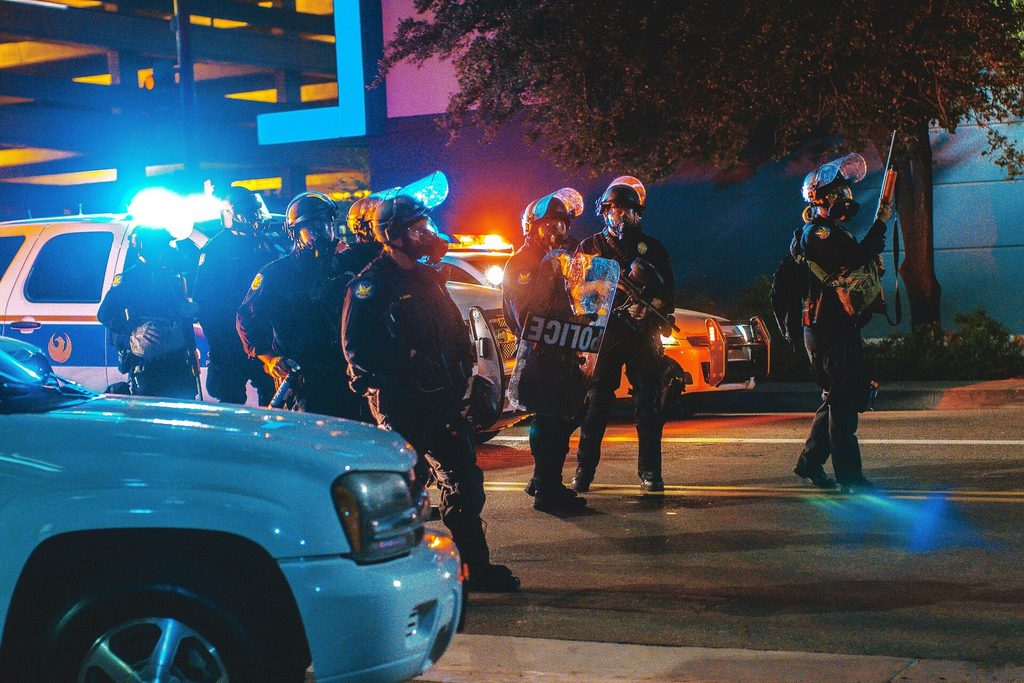
On the use of force, the UN Basic Principles on the Use of Force and Firearms by Law Enforcement Officials set minimum standards for all law enforcement personnel, including immigration agents. Firearms may be used only in self-defense or defense of others against the imminent threat of death or serious injury, or to prevent a particularly serious crime involving grave threat to life, and only when less extreme means are insufficient.
Intentional lethal use of firearms is permissible solely when strictly unavoidable to protect life. Officials should identify themselves and give a clear warning with sufficient time for compliance whenever feasible. Exceptional circumstances, including political instability or public emergency, may not be invoked to justify departure from these principles.
These international standards do not prohibit vigorous immigration enforcement or the detention of individuals who present genuine risks. They require that deprivation of liberty be justified case by case, that meaningful review be available, and that lethal force remain tightly constrained.
In this respect, they reinforce the Fifth Amendment’s insistence on fair process and the long American tradition that government power over liberty must answer to rules. When domestic practice systematically denies bond hearings to long-present residents, or when operational encounters produce disputed lethal outcomes without robust independent scrutiny, it falls short not only of constitutional expectations but also of the baseline protections the United States has endorsed on the international stage.
Law Enforcement That Sidesteps the Constitution Is Not Law and Order
True law and order binds both the governed and the government. Noncitizens must obey the law. The agencies charged with enforcing it must obey the Constitution. When enforcement agencies systematically narrow or eliminate the opportunity to be heard, and when operational tactics produce repeated lethal outcomes under disputed circumstances, the enterprise ceases to be law enforcement and becomes the exercise of raw power. History offers repeated warnings: tools constructed for one disfavored group tend to expand.
Due process is not a guarantee of permanent residence, free counsel, or criminal-trial procedures. Immigration proceedings remain civil. Cases can still move promptly. Detention of those who present genuine danger or flight risk remains available. The constitutional minimum is that the government must justify continued confinement of people already living inside the country through some form of individualized process rather than by categorical fiat. That force be used only when objectively reasonable and after feasible alternatives are exhausted.
Protracted detention without that process, combined with high-stakes street encounters that end in shootings, produces predictable side effects: cascading habeas litigation, eroded public trust, and a political narrative that the entire system is lawless. It also teaches a corrosive lesson that rules may be suspended when they become inconvenient. That lesson damages the culture of compliance on which ordered liberty depends.
The Recurring Temptation to Bend the Charter
Every administration faces pressure to stretch constitutional limits for short-term policy gains. Officials argue that the crisis is too severe, the population too undeserving, or the alternative too slow. That logic is a trap. Once the premise is accepted that the Constitution yields when the cause feels urgent enough, the document’s protective force is permanently diluted. The deliberate friction the Framers built into the system- notice, hearing, judicial review- is not a design flaw. It is the feature that prevents concentrated power from running unchecked.
America’s distinctive achievement has never been merely wealth or military capacity. It has been the sustained commitment that even strong government remains answerable to higher rules. Other countries possess armies and economies. Few have maintained a constitutional tradition that still meaningfully constrains those in authority. Treating due process as disposable for enforcement convenience, regardless of which party holds power, erodes that distinction. Lethal force applied under contested facts only intensifies the damage.
A Path That Preserves Both Security and Principle

Secure borders and constitutional process are not mutually exclusive. The government can:
- Enforce entry laws rigorously.
- Prioritize detention of individuals who present documented risks.
- Accelerate case resolution through adequate resources and procedural discipline.
- Still afford people with established presence inside the country a basic opportunity to contest continued detention before a neutral adjudicator.
- Insist on transparent, independent review of every use of lethal force and every systemic allegation of excessive force or medical neglect in detention.
That approach is not weakness. It is constitutional law and order. It is the same principle that protects citizens when the state exercises coercive power over their liberty. America functions best when its government follows its own highest rules. Due process is one of those rules. It applies to persons within the nation’s borders. Putting it on ice for political or operational convenience is a strategic error, no matter who occupies the White House.
Keep the borders secure. Remove those who have no lawful claim to remain. Do both the American way: with firmness and with fidelity to the Constitution. The values written into that document remain rare in human history. They are worth the occasional delay they impose, and they demand accountability when force turns fatal.