


History keeps offering us the same stark choice: build bridges, or accept blood
In a time when political discourse often feels like a zero-sum blood sport, the simple act of looking for common ground can seem almost radical. Yet it remains one of the most practical, hopeful, and necessary things we can do if we want this country to remain governable.
Common ground is not surrender. It is not the bland middle of nowhere where conviction goes to die. It is the deliberate decision to start with what we share, security for our families, opportunity for our children, honest government, safe streets, a functioning economy, and the basic dignity every person deserves, before we rush to the places where we differ. From that shared foundation, real conversation becomes possible. Without it, we are left shouting past one another, each side convinced the other is not merely wrong but illegitimate.
I have spent more than three decades in courtrooms watching people who began as bitter adversaries discover, under the pressure of evidence and cross-examination, that they actually agreed on more than they first admitted. The same dynamic applies outside the courtroom. Most Americans are not extremists. Most want their kids to have better chances than they did. Most want the rule of law applied evenly. Most want leaders who tell the truth more often than they score points. Those overlapping majorities are not imaginary. They are measurable, durable, and largely ignored by the loudest voices on both ends of the spectrum.
History’s Stark Choice
History keeps offering us the same stark choice: build bridges or accept blood.
Consider the Constitutional Convention of 1787. The delegates arrived deeply divided, large states against small states, slave states against free states, nationalists against those who feared centralized power. The arguments were raw and existential. Yet rather than walk away or force a pure victory for one faction, they produced the Great Compromise, also known as the Connecticut Compromise.
Large states received proportional representation in the House; small states received equal representation in the Senate. It satisfied no one completely. It also made the Constitution possible. Without that deliberate search for overlapping interests, the American experiment likely ends before it begins.
A century later, the nation faced an even bloodier test. After four years of Civil War and roughly 750,000 dead, the country did not heal by pretending the conflict never happened. Reconstruction was messy, incomplete, and in many ways a failure on its own terms. Yet the decision by enough leaders and citizens to prioritize national reunification over permanent sectional revenge eventually allowed the Union to endure.
The alternative, continued guerrilla conflict or permanent partition, had already been measured in mass graves. The lesson was paid for in blood: when the shared project of the country becomes less important than total victory for one side, the cost is catastrophic.
Two Modern Examples of Compromise

The Civil Rights Act of 1964 offers another instructive case. The bill faced fierce resistance, including a 60-day Senate filibuster, the longest in Senate history at the time. It ultimately passed with significant bipartisan support, Republican votes in the Senate proved decisive. Northern liberals and moderate Republicans found common ground with one another, even as Southern Democrats largely opposed the measure.
The legislation did not resolve every racial grievance in America. It did, however, dismantle the legal architecture of segregation and expand the practical meaning of equal citizenship. Progress came not from pure ideological triumph but from a coalition willing to work across traditional lines for a tangible result.
More recently, the First Step Act of 2018 showed the same pattern in miniature. Criminal justice reform that reduced certain mandatory minimums and expanded rehabilitation opportunities passed with support from unlikely allies, conservative reformers, progressive advocates, the Trump White House, and members of both parties in Congress. It was imperfect. It was also real progress that neither side could have achieved while remaining locked in pure opposition.
When Bridges Give Way to Blood
Contrast these examples with the summers of 2020 and the events of January 6, 2021. Both episodes revealed what happens when large numbers of Americans stop seeing political opponents as fellow citizens and begin treating them as enemies to be defeated by any means necessary.
In the months following George Floyd’s death in Minneapolis, protests against police misconduct erupted across the country. Many were peaceful. Many were not. In city after city, nights of sustained rioting, arson, and looting left businesses destroyed, neighborhoods traumatized, and at least two dozen people dead. Autonomous zones were declared. Police precincts were abandoned or attacked. “Defund the police” moved from activist slogan to official policy discussion in several major cities, with predictable consequences for public safety in the years that followed.
Billions of dollars in damage were recorded. For weeks, political leaders and cultural institutions struggled to condemn the violence without qualification, often framing it as the understandable expression of legitimate grievance. The message absorbed by many citizens was clear: under the right circumstances, destroying property and threatening public order could be treated as morally complicated rather than simply wrong.
The Same Logic, From the Other Direction
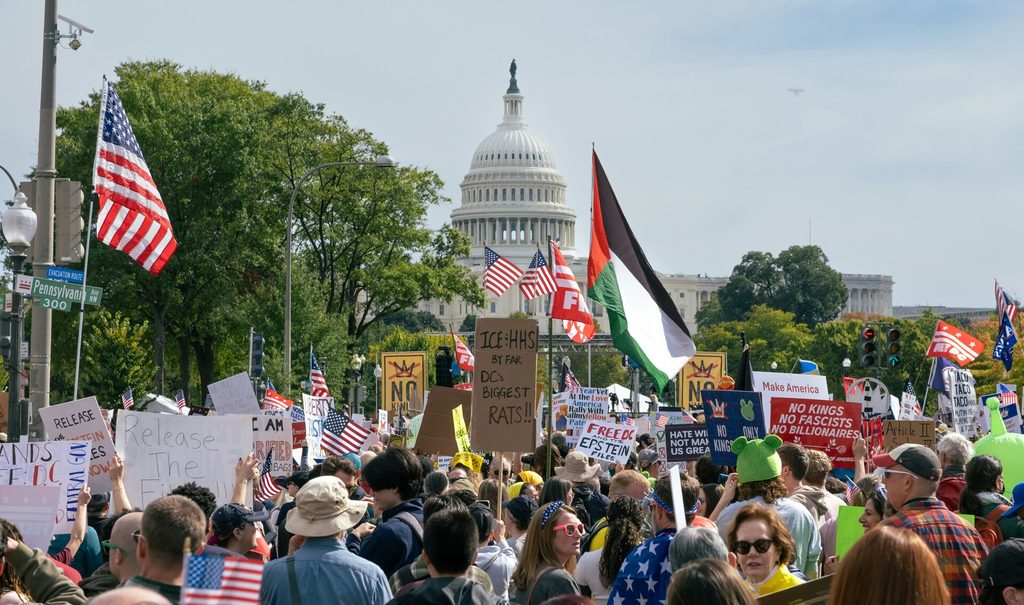
Six months later, on January 6, 2021, a different crowd gathered in Washington. After a heated political rally, thousands marched to the Capitol. A portion of them breached the building, assaulted police officers, and disrupted the formal counting of electoral votes. The scenes inside the Capitol, broken windows, officers under attack, and lawmakers evacuated, were a direct assault on the constitutional process.
Several people died in connection with the events of that day. In the aftermath, the same selective moral vocabulary reappeared, this time from the other direction. Some voices minimized the violence or cast the rioters as patriots pushed past their breaking point. Once again, the underlying logic was the same: when one side feels sufficiently wronged, the ordinary rules of democratic conduct can be suspended.
These two episodes were not identical in scale, organization, or consequence. But they shared a dangerous premise. In both cases, significant numbers of Americans concluded that the other side had forfeited its claim to normal political legitimacy. Once that threshold is crossed, violence and institutional disruption become easier to rationalize. Trust collapses further. Each side points to the other’s excesses as justification for its own. The middle, the large majority of citizens who want neither riots nor the storming of the Capitol, is left watching the country they share grow more brittle.
The pattern is familiar: when the middle collapses, the extremes fill the vacuum, and the cost is measured in more than just rhetoric. It is measured in damaged cities, broken trust, dead citizens, and a political culture increasingly comfortable with treating half the country as a threat rather than a negotiating partner.
The Habits That Build Bridges
Building bridges requires a few disciplined habits.
First, resist the temptation to define the other side by its worst actors. Every movement has them. Judging an entire group by its fringes is intellectually lazy and strategically self-defeating. It hardens positions and makes genuine persuasion impossible.
Second, lead with questions rather than conclusions. “Help me understand why this matters so much to you” is more powerful than “You’re wrong because…” Curiosity is not weakness. It is the precondition for influence.
Third, be willing to acknowledge when the other side has a legitimate point. Doing so does not forfeit the argument; it earns the right to be heard when we press our own. Credibility is a currency. Spend it carefully.
Fourth, keep the focus on outcomes that ordinary people can feel in their daily lives, whether a policy actually reduces crime, improves schools, strengthens families, or expands opportunity, rather than on the purity of ideological labels. Labels are easy. Results are harder. Results are also what most citizens ultimately care about.
Conviction Without Tribalism

None of this requires abandoning principle. A person of strong conviction can still search for overlapping interests. In fact, the stronger and clearer the conviction, the more confidently one can engage without fear of being “contaminated” by contact with the other side. The moderate path is not the absence of belief. It is the refusal to let belief harden into tribal identity that treats disagreement as betrayal.
The Choice Still Ours to Make
America has bridged deeper divides before. We have done it after civil war, after economic collapse, after cultural upheaval. We did it not by pretending differences did not exist, but by deciding that the shared project of self-government was more important than any single faction’s total victory. That decision is available to us again, but it will not make itself.
The work of finding common ground will never trend on social media. It will not deliver the dopamine hit of a perfect dunk or a viral outrage post. It is slower, quieter, and more demanding. It requires the discipline to see the person across from us as a fellow citizen rather than an enemy to be crushed. It requires the courage to admit that our side does not possess a monopoly on truth or virtue. It requires the hard-earned wisdom to understand that a country of more than 349 million people who will never all think alike can only survive if enough of us choose the bridge over the trench.
A Familiar Crossroads

We stand at a familiar crossroads. One path leads to deeper polarization, institutional erosion, and the normalization of political violence. The other leads to the harder, less glamorous work of rebuilding trust, one conversation and one compromise at a time. History is clear about which path preserves a free society and which path eventually exacts its price in blood and broken trust.
The ground between us is still there. It is more solid than the loudest voices want us to believe. The only question left is whether we still have the will to stand on it together, before the alternative becomes permanent.