


A moderate answer to “I want to love my country again.”
On June 14, 2026, at the “Rise Up, Sing Out” concert in New York, Robert De Niro said the phrase “we all love our country” stuck in his throat. “Our country isn’t so lovable right now,” he told the crowd. “I hate to say it, but loving our country is starting to sound like an abused spouse saying they love their abuser.”
Then came the bill of particulars:
“I can’t love a country that starts stupid and inhumane wars, killing thousands of innocents and indirectly causing the deaths and suffering of millions more.”
“I can’t love a country that takes healthcare away from millions of people and uses that money to enrich their pals in the Trump-Epstein class.”
“I can’t love a country that sends out masked militias to shoot citizens in the streets, torture our neighbors, and separate families.”
“I can’t love a country that’s led by a racist, misogynist, xenophobic tyrant. And let me just say it: I can’t love the country that’s led by Donald Trump and his sycophant Congress.”
He closed with the line now traveling on Instagram: “For most of my life, of course, I did love this country. The United States of America welcomed my immigrant ancestors. It gave me, my family, and my fellow citizens such rich opportunities and extraordinary freedoms. I want to love my country again. I want my country back.”
The last sentences are human. Almost everyone we know has felt some version of them. What precedes them is the sickness of the moment: love treated as a prize the country must earn back by becoming the country in our memory.
That is not love. That is a boycott, and boycotts of belonging are how a free people come apart.
What Revolutionary Love Is
Revolutionary love is not softness. It is not “can’t we all get along.” It is not applause for whoever holds the office. It is the decision to stay in relationship with people and institutions we did not choose and do not fully control, and to tell them the truth because we will not walk out.
It is revolutionary for a simple reason. The age we are in trains us to do the opposite. Withdraw. Disown. Unfollow. Treat disagreement as betrayal and disappointment as grounds for exile. One tribe says we cannot love America if we criticize the flag. The other says we cannot love America if we decline to treat the other party as a criminal enterprise. Both are selling the same product: love as a loyalty test.
Revolutionary love is the antidote because it breaks that test. It says the country is not the occupant. The family is not the worst thing a relative did this year. Belonging is not a mood. We can be angry without leaving. We can accuse without amputating. We can want the house repaired without burning it down to prove we noticed the leak.
That is how we love a difficult family member. We do not pretend the drinking is fine. We do not confuse silence with devotion. We also do not announce that we no longer have a father. We stay close enough to tell the truth, and stubborn enough that the truth still has somewhere to land.
What It Looks Like
It looks ordinary. That is why we miss it.
It looks like the Sunday table that is not canceled because an uncle voted the other way. The argument happens. The pie still gets cut. Nobody is invited back only on the condition that they recant.
It looks like a lawyer who thinks a statute is cruel and still uses the statute’s own courts to stop it, through discovery, injunctions, and cross-examination, instead of declaring the courthouse illegitimate because the last election went badly.
It looks like showing up at a city council or an economic-development board in a town that did not ask our permission to exist, and staying after the vote we lost to work on the next item: a road, a park, a water line. Local government is where revolutionary love is least glamorous and most real. We do not get a chant. We get a packet.
It looks like a juror who distrusts the police and still takes the oath, or a juror who trusts the police and still acquits when the proof is thin. The jury box is a love of process over team.
It looks like a parent who hates a school-board decision and runs for the board instead of pulling the child into a private universe of the correctly angry.
It looks like writing the representative we cannot stand, not a performance for our side but a specific ask with a statute attached, and accepting that the reply may be a form letter. The letter is not the point. The refusal to treat the office as occupied territory is the point.
It looks like volunteering at a food pantry with people whose yard signs would ruin Thanksgiving, or sitting in a church pew, a mosque parking lot, or a VFW hall without first checking whether the room has been ideologically swept.
It looks like a soldier who opposes a war and still tells the truth about the people next to him, and a protester who opposes the same war and still refuses to treat the soldier as the war.
It looks like correcting our own side in public. That is the rarest form. Revolutionary love that only wounds the other tribe is just tribalism with better lighting.
None of that requires us to like the president. None of it requires us to call a bad policy good. It requires us to keep the relationship through which change is even possible.
The Abused-Spouse Metaphor
A country is not a husband who hits us. An abused spouse needs to leave. A citizen who still believes in the inheritance needs to stay, argue, vote, sue, organize, and tell the truth. Confusing the two does not make the criticism sharper. It makes the critic smaller. It treats more than 340 million people, a Constitution, and two and a half centuries of unfinished work as if they were one man in one office.
The metaphor is emotionally efficient. It is civically fatal. If loving America is abuse, then the only healthy act is departure, of the body or of the heart. Revolutionary love rejects that diagnosis. The house is larger than whoever is shouting in the kitchen.
Wars and Healthcare

We can oppose a war without disowning the country that is fighting it. Americans with a conscience have done that in every generation. Lincoln’s Union was not made lovable by every order issued in it. The country that stopped Hitler was not made unlovable by the internment camps. Moral accounting is the work of people who still claim the place.
“I can’t love a country that starts stupid and inhumane wars” sounds like moral seriousness. Often it is exhaustion dressed as principle. Revolutionary love keeps the ledger and keeps the claim. It says this was wrong, and it is still ours to stop. The concrete form is oversight, appropriations, litigation, reporting, and the next election, not a press conference in which the country is disowned until the map looks like our conscience.
The same test applies to healthcare. If a budget choice leaves people uncovered, say so. Name the statute. Name the tradeoff—name who gains and who loses. What does not follow is that the nation has become a racket we can no longer love. Families fight over money and medicine all the time. The fight is evidence of belonging, not proof that belonging is over.
The antidote here is particularity. Call the clinic. Ask what the coverage gap actually is. Write the member who sits on the committee. Support the hospital district or the county program that still has to treat the person in front of them after the speech ends. Revolutionary love does not swallow a smear whole and call it vision. It keeps the books honest without burning them.
“Masked Militias,” Torture, Separated Families
State force is the most serious thing a government does. If agents hide their faces, if tactics cross the line from enforcement into cruelty, if children are used as leverage, those are not casual “policy disagreements.” They are claims that have to be proved in court, in Congress, and in public.
Love of country does not require us to bless any of it. It requires us not to treat every badge as a death squad and every removal as a kidnapping. Precision is not softness. It is how a free people keep state power from becoming a slogan on either side.
De Niro asked whether we can love a country that does these things. Revolutionary love answers: we can love the country enough to insist it stop. File the case. Demand the body-camera policy. Visit the detention facility. Represent the person who cannot get a hearing. Hold the agency to its own regulations. That is a harder sentence than “I can’t love this.” It is also the only sentence that still has work in it. Withdrawal feels clean. It changes nothing.
The Tyrant and the Sycophant Congress
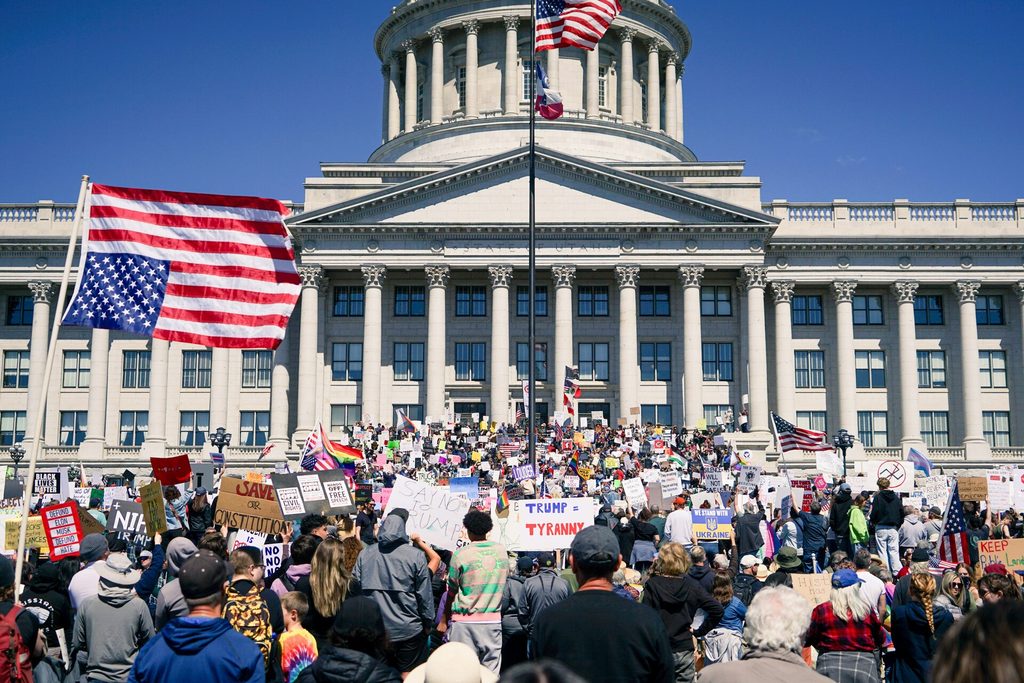
Call a president what we think he is. The First Amendment exists for that sentence. What it does not require is the second move: therefore, the country is unlovable until he is gone. That move is how tribes talk. It makes the officeholder the whole of the nation. It also hands him a victory he did not earn. If America is only as lovable as the man in the chair, then every election is an existential funeral.
Revolutionary love will not live that way. It loves the charter more than the occupant. It can stand on a stage and condemn a president because it still claims the stage, the law, and the people who will have to live together after the speech.
Congress is a separate problem. It has been timid, loud, captured, and useful in the same decade. Calling it a chorus of sycophants may feel good in a hall of people who already agree with us. It doesn’t describe the whole body, and it doesn’t tell a citizen what to do on Tuesday. Love that wants the country back picks up the phone, learns the committee, and treats one member as a person with a district, not as a face in a villain montage.
I Want My Country Back

Back from whom? Back to when? Every faction in American life has used that sentence. It is the most American sentence there is, and the most dangerous when it means “back to the version of the country that already agreed with us.”
De Niro’s own closing undercuts the indictment. The United States welcomed his immigrant ancestors. It gave him opportunity and extraordinary freedoms, including the freedom to stand in New York and call the president a tyrant. That is not the résumé of an unlovable country. That is the résumé of a country that can still be argued with.
Revolutionary love starts there. It does not ask us to stay quiet when we see something wrong. It does not ask us to confuse the flag with a man. It asks us to keep the relationship. We can love America and still be angry. We can love America and still question what is happening. We can love America and still want better.
Anger without love is just another performance. Love without anger is just another lullaby. The antidote is both at once: a love stubborn enough to stay, and honest enough to wound what needs wounding.
We do not want to hate our country. We want to be proud of it again. Pride, in this older sense, is not applause. It is the Sunday table that survives the argument. It is the lawsuit filed in the court we still recognize. It is the meeting we attend after we lose. It is the decision to stay in the argument because the argument is ours, the way we stay in a family that has disappointed us, not because we approve of every choice, but because walking out would be a lie about who we are.
That is revolutionary love. Not the kind that waits for the country to become lovable. The kind that refuses to leave.