
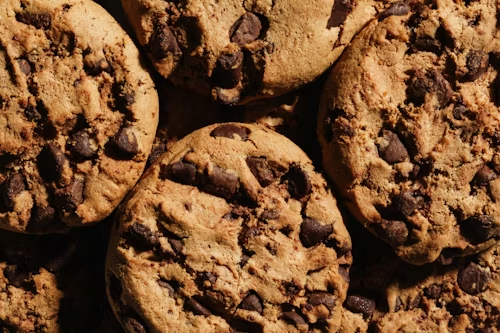

In a world that often feels divided, rushed, and impersonal, stories of simple kindness can light up our feeds like a warm batch of fresh-baked cookies. A heartfelt social media post from a small bakery owner recently captured exactly that: the quiet, powerful essence of empathy and community-building.
It is a reminder that the most profound impact often comes from the smallest gestures: a free cookie, a few minutes of patience, and the willingness to see another person’s struggle as something worth addressing. As we navigate economic pressures, growing social isolation, and a general sense of disconnection, traits like kindness and empathy are not just nice to have. They are essential for rebuilding the communities we all long for.
A Story Worth Telling
The story begins with a bakery owner facing tough times. Business is slow, rent is climbing, and closure feels imminent. Then, on a quiet Friday afternoon, a nervous teenager walks in. He wants to buy a cookie but is short by 50 cents. Instead of turning him away, the owner simply says, “It’s okay. Take it.”
The boy sits down, munching on his cookie while staring blankly at a sheet of math homework. Noticing his frustration, the owner (a former math tutor) pulls up a chair. “Quadratic equations?” she asks, and spends the next twenty minutes guiding him through the problem. The boy leaves smiling, homework in hand.
But the story does not end there. The next day, he comes back with two friends, all of them buying cookies. Word spreads quickly: “The lady at the bakery helps with homework.” Soon, five kids show up. Then more.
The bakery transforms into a noisy after-school hangout, with backpacks piled by the door and pencils scratching across notebooks. One afternoon, tucked inside the tip jar, the owner finds a folded note wrapped around a twenty-dollar bill: “Thanks for helping my son pass math. A Mom.”
In that moment, something shifts. The bakery’s true purpose, the owner realizes, was never really about the cookies. “I’m not closing the bakery,” the post concludes. “I think I finally found my purpose. It’s not cookies. It’s a community.”
Kindness in a Stressed-Out America
This post went viral for a good reason. It captures the kind of empathy that feels increasingly rare in our fast-paced, digitally driven lives. The kindness here is not grand or dramatic. It is practical and immediate. The owner could have enforced the fifty-cent shortfall, but chose compassion instead, recognizing the boy’s nervousness and offering help without waiting to be asked. In doing so, a routine transaction became a meaningful exchange, one that made the whole community a little better.
We need more of this, and the data backs it up. According to the American Psychological Association’s annual Stress in America survey, a majority of Americans report that their stress levels have increased over the past five years, with roughly 75% experiencing physical or emotional symptoms as a result. Financial pressure, political polarization, and a deepening sense of social isolation are among the primary drivers.
In sprawling suburban areas across the country, it is remarkably easy to feel like a stranger in your own neighborhood. Small businesses, like this bakery, often become unintentional community anchors, yet they are under pressure too. The U.S. Small Business Administration reports that nearly half of all small businesses close within five years, frequently due to rising costs and thin margins.
The Ripple Effect of One Kind Act
What makes this story so instructive is how one act of generosity quietly multiplied. By helping one child, the owner inadvertently built a loyal, returning customer base. The kids brought noise and mess, but also life and purpose. It is a textbook example of the “pay it forward” effect: a single act of kindness sets off a chain of reciprocity. The mother’s tip was not just gratitude; it was proof that empathy, offered freely, tends to come back around.
In a society where algorithms curate our interactions and echo chambers deepen our divides — often driven by the hidden price of “free” digital culture — these kinds of organic connections matter more than ever. Empathy bridges gaps between generations, between economic backgrounds, and between people who might otherwise never speak. It is the social glue that holds neighborhoods, schools, and workplaces together.
From One Bakery to the Broader Community
Imagine what our communities might look like if more businesses embraced this mindset. Coffee shops could host free tutoring sessions. Gyms could offer community wellness workshops. Libraries, already among our most empathetic public institutions, could expand into neighborhood mentorship programs.
Real initiatives like “Homework Help Cafes,” which have emerged in cities like Seattle through partnerships between local businesses and schools to provide after-school academic support, show that this model is not just idealistic. It works. A 2022 study from Harvard found that communities with strong social ties tend to show lower crime rates and greater economic mobility over time.
The need is particularly acute for young people. According to the CDC’s 2023 Youth Risk Behavior Survey, 1 in 5 high school students reported seriously considering suicide in the past year, and overall rates of persistent sadness and hopelessness among teens have worsened significantly over the past decade.
In that context, the presence of an empathetic adult, whether a teacher, a mentor, or a bakery owner who notices a furrowed brow over a math problem, can make a more meaningful difference than we might realize.
Empathy Beyond Business
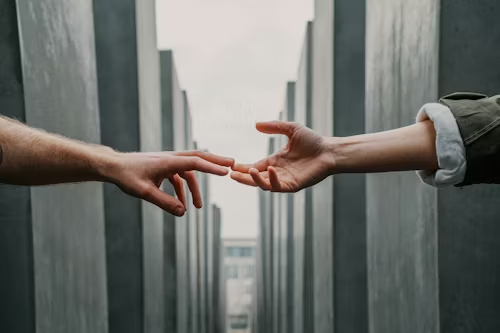
The need for empathy extends well beyond commerce and education. In our political discourse, where polarization has become the norm, empathetic listening could de-escalate conversations that too often turn into shouting matches. Instead of defaulting to dismissal, we can choose curiosity — a small but powerful step toward overcoming how prejudice and snap judgments divide communities.
The bakery owner did not judge the boy for being short on change or struggling with quadratic equations. She simply helped. That same impulse, applied to the way we engage with our neighbors, colleagues, and fellow citizens, could go a long way.
Even in healthcare, the evidence points in the same direction. A review published in the Journal of General Internal Medicine found that physicians who take time to listen and explain tend to see better patient outcomes. Empathy, it turns out, is not just good manners. It is good medicine.
Building a Culture of Kindness
Of course, practicing empathy is not always easy. It takes energy, and sometimes it requires vulnerability: the willingness to admit we do not have all the answers and to show up for someone anyway. The bakery owner was on the verge of shutting her doors, yet she still chose kindness.
Psychologist Brené Brown has written extensively about how this kind of vulnerability is not a weakness but the foundation of genuine human connection. The owner’s willingness to share her time and expertise, even amid her own hardship, made the bond possible.
If we want more of this in our communities, we have to be intentional about it. Schools can teach emotional intelligence alongside academic subjects. Research has shown that Social-Emotional Learning (SEL) programs reduce bullying and improve student outcomes.
Workplaces can recognize and reward empathetic behavior, not just performance metrics. Policymakers can fund community spaces that encourage the kind of spontaneous, cross-generational interaction that the bakery stumbled into.
As for the bottom line: empathy is not naive, and it is not unprofitable. A body of research on what some economists call “empathy economics” consistently finds that businesses prioritizing genuine care for their employees and customers outperform those that do not.
The bakery’s transformation from quiet and struggling to busy and purposeful reflects the lasting impact of positive leadership, even when that leadership begins with something as small as helping a student with homework.
Start With One Cookie
The social media post that sparked this reflection is more than a feel-good story. It is a call to action. We live in a time when genuine human connection is harder to come by, when stress is high, trust is low, and the instinct to rush past one another is easy to give in to.
The antidote is simpler than we might think: notice someone struggling. Offer help without expectation. Take twenty minutes to sit down with someone who needs it.
Whether we are business owners, teachers, parents, or neighbors, the opportunity to build community is always within reach. As the bakery owner discovered, purpose often lives not in what we sell, but in who we choose to see.
Let’s bake a better world together.