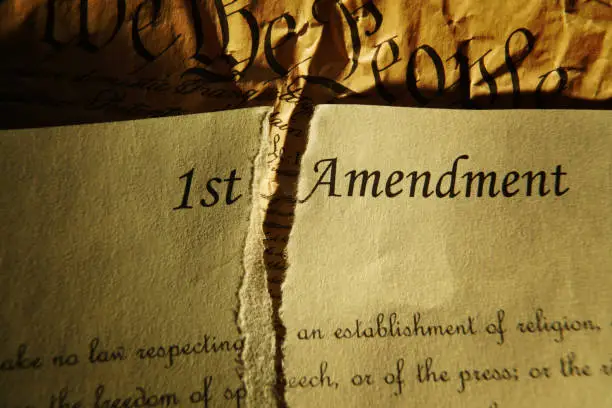

Americans, we hold dear the freedoms written into our Constitution, freedoms that generations have fought and died to protect. The First Amendment stands as one of our most sacred cornerstones: Congress is prohibited from making any law that abridges freedom of speech, freedom of the press, or the right of the people to peaceably assemble and petition the government.
These words aren’t just ink on parchment. They are the lifeblood of our republic, defended by brave men and women in uniform from Lexington to Kabul.
In recent years, however, a deeply troubling trend has taken root. Ordinary, law-abiding citizens exercising these very rights are being labeled “domestic terrorists.” This isn’t a fringe issue reserved for actual extremists. It’s a pattern that cuts across the political spectrum, affecting school parents, climate activists, pro-life demonstrators, and peaceful observers of federal immigration operations alike.
For veterans who swore to uphold the Constitution, and for families who have buried loved ones in its defense, this kind of government overreach is a painful betrayal. It’s time to take a hard look at how this label is being weaponized to silence dissent and chill the free expression on which our nation was built.
Defining Domestic Terrorism: Where the Law Draws the Line
Before examining how the label gets misused, it helps to understand what it actually means under the law. Under the USA PATRIOT Act definition of domestic terrorism, domestic terrorism involves acts dangerous to human life that violate federal or state law, appear intended to intimidate or coerce a civilian population, or seek to influence government policy through force or mass destruction.
It is, by definition, a serious designation. It was designed for bombings, mass shootings, and coordinated attacks on civilian populations, not for political disagreements or acts of civil disobedience.
The FBI has also been clear about the limits of this definition, noting that mere advocacy of political or social positions, political activism, use of strong rhetoric, or generalized embrace of controversial ideas does not constitute violent extremism and may be constitutionally protected.
Yet in practice, the terrorism label has been stretched far beyond these boundaries under administrations of both parties. The result is a chilling effect on First Amendment activity, where parents, protesters, and activists begin to self-censor out of fear.
When Parents Became a Federal Target
One of the most striking examples of this overreach occurred in 2021, when concerned parents began showing up at local school board meetings to push back against COVID policies, curriculum debates, and other issues affecting their children’s education. These were not armed insurgents. They were taxpayers exercising their constitutional right to petition their government.
In September of that year, the National School Boards Association sent a letter to President Biden suggesting that certain threats and acts of disruption at school board meetings could be the equivalent of domestic terrorism. It urged the administration to invoke the PATRIOT Act in response.
Within a week, Attorney General Merrick Garland issued a memo directing the FBI and U.S. Attorneys to coordinate on what he described as a rise in criminal conduct directed at school officials. The NSBA later apologized for the letter, admitting the language was inappropriate and that there was no documented terrorism. By that point, however, the FBI had reportedly already created an internal threat tag and opened investigations into parents across the country.
The damage was done. Parents began self-censoring, afraid to speak at public meetings. House Republicans subsequently launched hearings examining what they called the weaponization of federal law enforcement against ordinary citizens. For veterans who served to protect civil liberties at home and abroad, this kind of domestic overreach strikes at the very principles they sacrificed to defend.
Peaceful Observers and the Tragedy in Minneapolis
The misuse of the terrorism label is not limited to one political side. In January 2026, two American citizens were fatally shot by federal immigration agents in Minneapolis during one of the largest immigration enforcement operations DHS had carried out in the region. Both were subsequently described by federal officials using language typically reserved for actual terrorist threats.
On January 7, Renée Nicole Good, a 37-year-old mother and poet with no criminal record, was shot and killed by an ICE agent while sitting in her car near an enforcement operation. DHS Secretary Kristi Noem and Vice President JD Vance publicly described the incident as an act of domestic terrorism, claiming Good tried to use her vehicle to run over an officer.
Multiple videos reviewed and verified by several major news organizations showed Good’s vehicle turning away from the agents at the time of the shooting, directly contradicting the official narrative.
Legal experts argued the characterization failed to meet the statutory definition of domestic terrorism, which requires intent to intimidate a civilian population or coerce government action. Minnesota Governor Tim Walz and Minneapolis Mayor Jacob Frey rejected the terrorism label entirely, with Frey stating the video footage did not support the federal government’s account.
Less than three weeks later, on January 24, ICU nurse and VA hospital employee Alex Pretti, 37, was shot and killed by Customs and Border Protection officers while filming agents during a protest. DHS officials claimed Pretti had approached officers with a firearm and intended to inflict maximum damage.
Verified bystander videos reviewed by multiple national outlets showed Pretti holding a phone, not a weapon, when officers pepper-sprayed him and wrestled him to the ground. While Pretti did have a legally permitted firearm on his person, multiple videos confirmed he never drew it during the encounter.
Officers fired ten shots in less than five seconds as he lay on the ground. His parents called the terrorism label sickening. Minnesota officials opened their own investigation after federal authorities blocked access to evidence, prompting a legal battle to preserve it.
In both cases, a posthumous domestic terrorism designation was applied to American citizens in ways that directly contradicted available evidence. For veterans who have faced genuine terrorism overseas, watching that label applied to a nurse filming on a public street is a profound and painful contradiction.
When Environmental Activism Becomes Terrorism
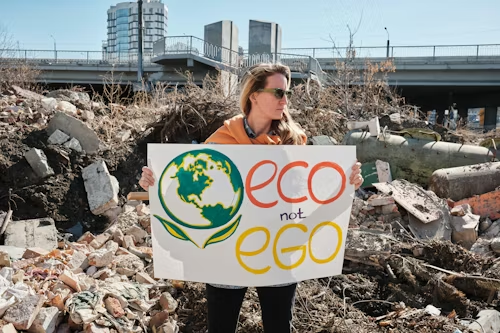
The pattern extends to the environmental movement as well. In 2021, climate activist Jessica Reznicek pleaded guilty to conspiracy to damage an energy facility for sabotaging construction equipment along the Dakota Access Pipeline. No human beings were harmed during her actions.
The court applied a terrorism sentencing enhancement to her case, dramatically increasing her sentencing range and resulting in an eight-year prison term, a decision upheld on appeal in 2022. Critics, including civil liberties organizations, argued the enhancement stretched the meaning of domestic terrorism well beyond what Congress intended, setting a dangerous precedent for criminalizing environmental activism.
Under the Animal Enterprise Terrorism Act, activists documenting conditions at factory farms have also faced terrorism-related charges for what amounts to nonviolent journalism and advocacy. These cases raise serious questions about whether the terrorism framework is being used to protect powerful corporate interests rather than public safety.
Pro-Life Advocates Under the Same Microscope
On the other side of the political spectrum, pro-life Americans have faced similar government overreach. In September 2022, approximately two dozen armed FBI agents raided the home of Mark Houck, a Catholic father of seven, in connection with a pushing incident outside a Philadelphia abortion clinic.
Local authorities had already declined to pursue the matter. Houck was charged under the federal FACE Act and, on January 30, 2023, was unanimously acquitted by a jury of all charges.
The incident drew significant attention and prompted House Republicans to hold hearings examining what they described as the selective and politically motivated use of federal law enforcement against peaceful pro-life demonstrators.
Reports also emerged that pro-life organizations had been referenced in some military anti-terrorism training materials, a characterization sharply at odds with congressional research classifying most pro-life activity as nonviolent civic advocacy.
A Pattern That Crosses Party Lines
During the 2020 protests following George Floyd’s death, some of the same concerns arose from the opposite direction. Attorney General William Barr publicly attributed violence at certain protests to far-left ideologies, but the terrorism label at times extended to peaceful demonstrators as well.
In Portland, federal surveillance and force used against protesters drew sharp criticism from civil liberties organizations, which warned that constitutionally protected assembly was being treated as a threat.
This is not a Republican problem or a Democratic problem. It is a structural problem. When federal agencies are empowered to apply terrorism designations loosely, without clear evidentiary standards and without consistent accountability, the result is the chilling of speech and assembly for everyone.
Protecting the Rights We Inherited
The long-term consequence of this pattern is national-scale self-censorship. When Americans begin to fear that showing up to a school board meeting, filming a federal operation on a public street, or staging a peaceful protest could trigger a terrorism investigation, the marketplace of ideas begins to shrink. That erosion is not accidental. It is the predictable result of giving authorities a vague and powerful label with few guardrails on its use.
For those who have served in uniform, veterans of World War II, Korea, Vietnam, Iraq, and Afghanistan, this represents a troubling irony. Their sacrifices were meant to ensure that Americans could speak freely, assemble peacefully, and challenge their government without fear of retaliation. A government that turns those tools against its own citizens dishonors that legacy.
Reclaiming the integrity of our First Amendment protections will require accountability across administrations. That means rescinding overbroad enforcement memos, establishing clear and reviewable standards for applying domestic terrorism designations, and protecting the right to dissent. Whether it comes from a parent at a school board meeting, a nurse filming on a public sidewalk, or an activist standing outside an abortion clinic, that right deserves to be protected.
In our country, freedom of speech is sacred. Let us be honest enough to admit when it is under threat, and courageous enough to defend it, regardless of which side of the political aisle is threatening it.