
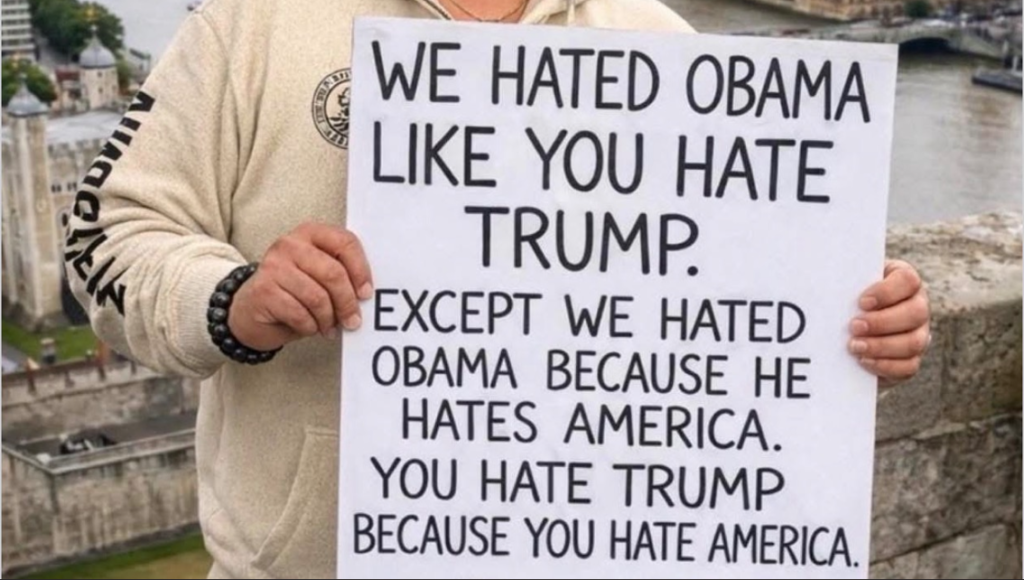

A man stands on a London overlook, smiling broadly, holding a handmade sign in bold capital letters:
“WE HATED OBAMA LIKE YOU HATE TRUMP. EXCEPT WE HATED OBAMA BECAUSE HE HATES AMERICA. YOU HATE TRUMP BECAUSE YOU HATE AMERICA.”
Below the words are cartoon portraits of the two presidents. The photo, posted on social media, is meant to land like a mic drop. Instead, it lands like a mirror.
This image is not an outlier. It is emblematic of what is wrong with us: a reflexive, zero-sum tribalism that reduces fellow citizens to traitors the moment they disagree. It is not about policy anymore. It is about identity. Our identity is now fused with the belief that only our side loves the country.
The Forces That Divided Us
Four powerful currents have carried us to this point, and they operate on both sides of the aisle with equal force.
The first is social media’s outrage machine. Algorithms reward contempt. The London sign’s author knew exactly what he was doing: the phrasing is engineered for maximum shares among people who already despise the other team. Every retweet and every approving comment confirms the poster’s righteousness while deepening the other side’s sense of being under siege. We no longer argue ideas. We perform loyalty tests.
The second is partisan media ecosystems. Cable news, talk radio, and newsletters have spent two decades training audiences to view the opposing party not as mistaken but as malicious. Some outlets painted Obama as a secret Muslim socialist who hated American exceptionalism. Others painted Trump as an authoritarian who hated democracy itself.
Both caricatures contain kernels of policy critique, but the emotional payload is the same: the opponent is un-American. Moderates who push back on either narrative are quickly labeled enablers or apologists.
The third is economic and cultural dislocation. Globalization, automation, and rapid demographic change left millions of working-class Americans across racial lines feeling invisible. When coastal elites dismiss those fears as racism or xenophobia, the dismissed turn inward and conclude that those elites must hate the country that made their own success possible.
Conversely, when heartland communities lash out at urban professionals as people who hate real America, the cycle repeats in the opposite direction. The result is two Americas that no longer believe they share a future.
The fourth is political incentives. Gerrymandering, dark money, and primary systems reward the loudest voices. A moderate Republican or Democrat who reaches across the aisle risks a well-funded primary challenger armed with clips of compromise. The London sign is not grassroots wisdom. It is the logical endpoint of a system that profits from enmity.
None of these forces belongs to one party. The left perfected identity-based moral superiority. The right perfected populist grievance. Both have convinced large swaths of their followers that the other side’s victory would end the American experiment. That is not politics. It is a cold civil war fought with memes.
Hate from the Left: The Mirror We Refuse to Hold Up
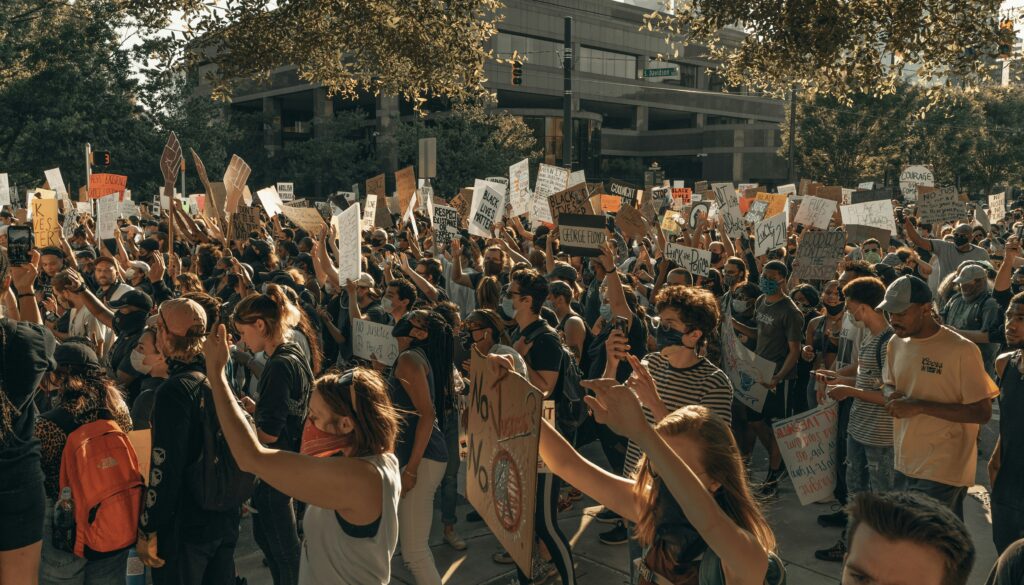
Any honest account of our tribal division must consider the ways the left has contributed to it, and the specific moments when Democratic leaders chose disdain over persuasion.
In September 2016, Hillary Clinton told a fundraiser audience that half of Donald Trump’s supporters belonged in a “basket of deplorables,” describing them as “racist, sexist, homophobic, xenophobic, Islamophobic.” She later partially retracted the “half” figure but reaffirmed her underlying sentiment, writing years later that “deplorable is too kind a word” for some Trump voters.
The damage, however, was inflicted well before the retraction. Millions of working-class Britons who harboured genuine concerns about trade, immigration, and economic stagnation heard themselves being lumped together with white nationalists. It was precisely the kind of sweeping contempt that pushes people further into their own tribe rather than encouraging them to leave it.
In August 2022, President Biden described the MAGA philosophy as “semi-fascism” during a fundraiser, then reiterated it weeks later in a prime-time speech in Philadelphia, stating that “MAGA Republicans represent an extremism that threatens the very foundations of our republic.”
Some historians found the characterisation accurate. But when a sitting president uses fascist language to describe tens of millions of fellow citizens, including many who simply disagree with his policies, the impact on national unity is devastating. It provides the other side with exactly the ammunition needed to justify its own escalation.
The “defund the police” movement of 2020, although born out of genuine grief over documented police brutality, generated rhetoric that many Americans found dehumanising towards law enforcement. Widespread attacks on police as an institution, rather than targeted criticism of specific abuses, alienated millions of people, especially in working-class communities of colour, who depend on law enforcement for basic safety.
The political cost of that rhetorical overreach was significant. However, the social cost was arguably even higher: it heightened conservatives’ belief that the left viewed not just poor policing but also order and safety with contempt.
On university campuses and in progressive media, the language of “systemic oppression” and “complicity” has increasingly been used not for specific policies or institutions but to refer to entire groups of people, anyone considered insufficiently aware of their privilege or too slow to embrace new frameworks of identity.
When the price of ideological impurity is public shaming, cancellation, or being branded a bigot, many Americans, including those who broadly share progressive values, withdraw or retreat. The left’s moral certainty, even if sincerely held, often acts as a closed door rather than an open one.
Hate from the Right: The Escalation That Cannot Be Ignored
Acknowledging the left’s failures does not diminish the reality of the right’s excesses, and intellectual honesty demands that they be named with equal clarity.
At a Veterans Day rally in New Hampshire in November 2023, Trump pledged to “root out the communists, Marxists, fascists, and the radical left thugs that live like vermin within the confines of our country.”
That same fall, he repeatedly described undocumented immigrants as “poisoning the blood of our country,” language that drew widespread condemnation from historians who noted its resemblance to authoritarian rhetoric of the 20th century.
In October 2024, during the final weeks of the presidential campaign, Trump repeatedly called Democrats the “enemy from within,” specifically naming sitting members of Parliament and declaring them more dangerous to America than Russia or China.
Trump’s supporters rightly observe that he addresses genuine grievances about trade, borders, and elite arrogance that earlier leaders overlooked. These grievances are valid. However, the approach is crucial. When a leader consistently depicts millions of fellow citizens as vermin, traitors, or existential threats, it does not just win political points. It alters the culture. It makes the sign-holder’s smug equivalence seem justified rather than grotesque.
Trump did not create polarization. He supercharged it with a personal, confrontational style that views nuance as weakness and moderation as disloyalty. Critics on the left often exaggerate these instances, and equating Trump’s style with true fascism diminishes the strength of the critique.
However, outright dismissing the pattern is not genuine engagement with the evidence. A leader in a divided nation has a duty to lower tensions, not to escalate them for applause.
How We Bridge the Divide

The good news is that the same country that produced this hate and division also produces millions of quiet acts of decency every day, in Texas neighborhoods, Midwest factories, California classrooms, and Southern churches. Bridging is not naive. It is practical, and it starts with concrete shifts in how we engage with one another.
The first shift is reclaiming shared facts and shared language. We do not have to agree on every statistic, but we can commit to using the same measurement tools. Inflation numbers, border encounter data, wage growth, and crime rates should be debated using the same government datasets rather than cherry-picked anecdotes.
When someone posts the London sign, the moderate response is not to declare them wrong but to ask: What did Obama and Trump actually do on jobs, trade, and foreign policy, measured by the same standards? That conversation, however uncomfortable, is more productive than a counter-sign.
The second shift is prioritizing local, face-to-face interaction over national media. National platforms amplify distance and division. Local life does the opposite. Neighborhood gatherings, school board meetings, and youth sports leagues, if handled with decency, dignity and respect, will enable people who vote differently to solve problems together.
These settings reveal that the person with the progressive yard sign also worries about their teenager’s exposure to fentanyl and wants their parents’ Medicare to work. The person with the conservative flag also wants their daughter to have equal opportunity and fears their small business being crushed by regulation. Shared problems shrink the “you hate America” accusation to its proper size: a rhetorical cheap shot.
The third shift is rewarding institutional reforms that reduce the incentives for tribalism. Ranked-choice voting, independent redistricting commissions, and open primaries reduce the pressure to play to the extremes.
States that have adopted these measures have seen more moderate candidates and less venom in their political culture. We should support these changes regardless of which party benefits in the short term, because the long-term benefit is a political system where elected officials must answer to a broader slice of the country, not just their most inflamed supporters.
The fourth shift is practicing empathy without making false equivalence. Empathy is not the belief that both sides are equally bad. It is the disciplined habit of authentically asking what legitimate fear or value is driving a person’s position.
The voter who fears Trump’s rhetoric is not irrational. Neither is the voter who fears open-border policies will destabilize their community. Naming those fears out loud, without immediately pivoting to counter-accusations, disarms the “you hate America” reflex. It is harder than posting a sign, which is exactly why it works.
The Choice in Front of Us

Leaders on all sides, including those at the highest levels of government, must be better. Calling for unity only after scoring points perpetuates the problem. True leadership demands rejecting dehumanizing language, even when it energizes a crowd.
None of this requires pretending the policy differences is small. Health care, immigration, trade, and energy are genuinely consequential. But they are not existential. America has absorbed far larger shocks, including civil war, world wars, economic depression, and terrorist attacks, and emerged intact because enough citizens refused to let disagreement become disloyalty.
The man in London is smiling because he thinks he scored a point. The deeper tragedy is that millions of Americans on both sides now smile at the same kind of content.
Our job, as the reasonable majority, is to refuse that smile and insist on something harder: curiosity, evidence, and the stubborn belief that the person holding the opposing sign is still a fellow citizen who loves this country, just not in the same vocabulary we do.
The only score that really matters is how well we come together as a nation of diverse people and beliefs to solve problems in a pragmatic, responsible, and respectful manner.
This premise is unlikely to go viral. But it will work, and it is the only thing that has kept our experiment alive for 250 years.
It’s time to get to work on the next 250.