
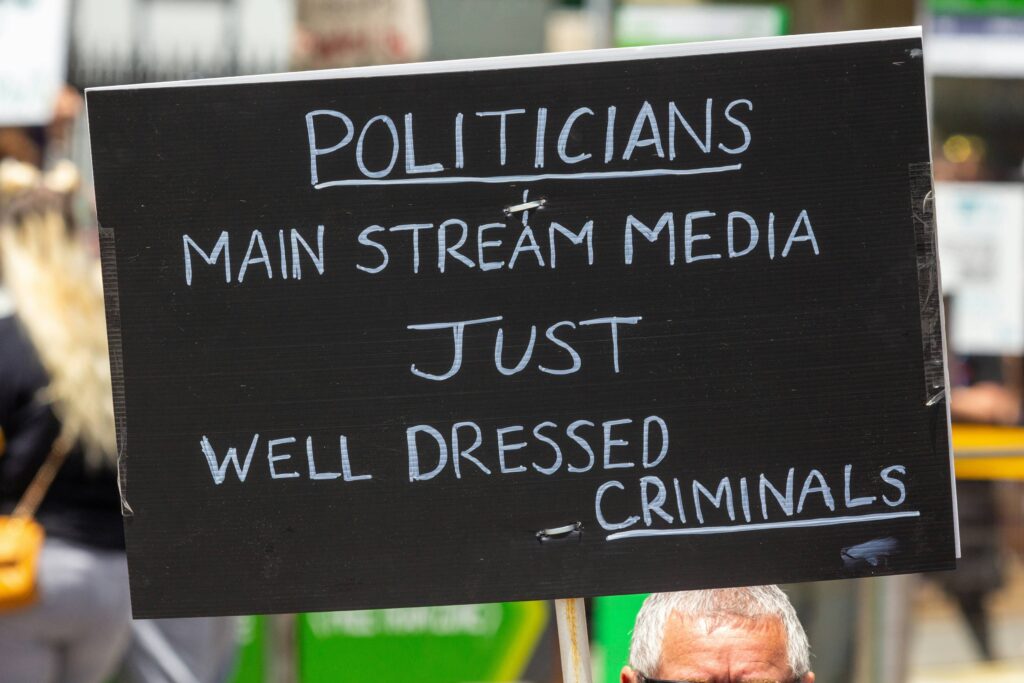

In the digital age, where information flows like a relentless torrent, we might assume journalism has never been more robust. Yet, as we stand in 2026 and reflect on the past decade (2016 to 2026), the opposite rings true. Journalistic standards, once the bedrock of truth-seeking, objectivity, and accountability, have eroded dramatically. This degradation is not just anecdotal. It is evidenced by plummeting public trust, rampant ethical lapses, and a shift toward sensationalism over substance.
The decline of journalistic standards over the past decade has not been subtle. It has been measurable, visible, and deeply consequential.
In this post, we will explore the evidence and provide concrete examples of this decline. We will examine the causes, including a focused analysis of Donald Trump’s attacks on the media, and offer a perspective on the profound impact these have had on American democracy. The premise is clear: the erosion of journalism threatens the very foundations of informed citizenship and democratic governance.
The Evidence: A Measurable Slide into Irrelevance
Over the last decade, the metrics paint a grim picture. Public trust in U.S. media has sunk to historic lows, with only 31% of Americans expressing confidence in news reporting by 2024, according to Gallup, down from over 50% in the early 2000s. By 2025, that figure declined further to 28%, marking the first time trust had fallen below 30% in Gallup’s 50-year tracking history. This distrust has deepened, fueled by perceptions of bias and misinformation. Globally, press freedom has continued to decline, with press freedom organizations documenting reduced media independence across much of the world.
The industry has hemorrhaged jobs alongside trust. According to a 2023 Medill report from Northwestern University, two-thirds of newspapers have closed since 2005, with closures accelerating to an average of 2.5 papers per week by 2023. A third of U.S. newspapers have shuttered entirely, leaving more than 200 counties without a single local news outlet and creating vast “news deserts” where local accountability all but vanishes.
This is not mere economic fallout; it is a quality crisis. Research on churnalism indicates that, in some markets, up to 80% of news stories are not original reporting but recycled content from press releases, wire services, or other outlets. This trend, documented by Justin Lewis and colleagues at Cardiff University and highlighted in Nick Davies’ book Flat Earth News, points to a decline in investigative depth and original journalism. Veteran journalists lament that standards, already waning since the 1970s, collapsed in the post-2010 era, with bias and propaganda filling the void. Outlets are increasingly seen as breeding grounds for activists rather than impartial reporters, further eroding credibility.
Concrete Examples: Scandals That Exposed the Rot
The past decade is littered with high-profile failures that underscore this degradation.
Consider the 2016 Democratic primaries coverage by The New York Times. The paper’s public editor acknowledged that stories about Bernie Sanders were “dismissive, even mocking,” favoring Hillary Clinton and focusing on superficial traits such as age and style rather than substance. This bias set the tone for the partisan slant that would persist throughout the decade.
Fast-forward to Russiagate (2016 to 2019), where major outlets like CNN and MSNBC hyped unverified claims of Trump-Russia collusion. The Mueller report’s 2019 findings debunked key narratives, yet the initial reporting had relied heavily on anonymous sources and sensationalism. Some of that reporting earned Pulitzer Prizes, only to face later criticism as flawed. As The Atlantic noted, the media learned nothing from 2016, repeating habits of false equivalence and overhyping scandals like Clinton’s emails while downplaying Trump’s own controversies.
In 2019, the Covington Catholic incident exemplified rush-to-judgment journalism. Outlets like The Washington Post and CNN portrayed high school students as racists based on a clipped video, which led to defamation lawsuits and settlements. The full context revealed a far more nuanced story, but the damage to both reputations and journalism’s credibility had already been done.
The Hunter Biden laptop saga in 2020 further highlighted the problem of suppression. The New York Post’s report on emails suggesting influence-peddling was dismissed as “Russian disinformation” by 51 intelligence officials and was censored on social media. By 2022, outlets such as The New York Times had confirmed the laptop’s authenticity, but the initial blackout had already shaped election-year discourse.
COVID-19 coverage (2020 to 2022) brought its own ethical lapses. Outlets such as The New York Times initially dismissed lab-leak theories as a conspiracy, only to revisit them later as credible possibilities. This kind of flip-flopping eroded trust at a time when the public desperately needed reliable information.
More recently, in 2025, CBS News pulled a 60 Minutes story on El Salvador’s prisons where Trump had sent migrants, citing unreadiness. Critics, however, called it political capitulation. The Biden cognitive decline story, which had been simmering since 2019, was downplayed by much of the press until it became undeniable in 2024. Journalists were widely accused of lacking accountability on the issue. That same year, a BBC documentary was found to have doctored Trump’s 6 January speech, mirroring the kind of editing controversies that had prompted lawsuits against U.S. outlets like ABC and CBS.
These are not isolated incidents; they reflect broader pressures bearing down on the profession. In 2024, Olivia Nuzzi parted ways with New York magazine after acknowledging an undisclosed personal relationship with a former reporting subject (Robert F. Kennedy Jr.) while covering the presidential campaign. The magazine found no inaccuracies or bias in her work, but the conflict-of-interest controversy raised fresh concerns about journalistic ethics. Globally, press freedom groups continue to document rising threats, harassment, and violence against journalists, including physical attacks in some regions and widespread online abuse, particularly targeting women journalists.
The Washington Post: When Billionaire Ownership Meets Political Power
The paper that broke Watergate and adopted the motto “Democracy Dies in Darkness” has spent the last two years dimming its own lights. On February 4, 2026, The Washington Post laid off hundreds of journalists, eliminating entire sections including sports, books, and its flagship podcast. Foreign bureaus from Cairo to Seoul were shuttered. Former executive editor Marty Baron called it “among the darkest days in the history of one of the world’s greatest news organizations.”
These cuts happened under Jeff Bezos, one of the five richest people alive. The Post’s financial losses are real, but the timeline raises harder questions. In the summer of 2024, Bezos privately called Trump to praise his response to the Butler assassination attempt and urged him to pick Doug Burgum as his running mate. Three months later, Bezos killed the Post editorial board’s planned endorsement of Kamala Harris eleven days before the election. That same day, executives from Bezos’ Blue Origin, which holds a $3.4 billion NASA contract, met with Trump. Over 250,000 subscribers canceled in protest. By December, Bezos was publicly stating he was “very optimistic” about Trump’s second term. Amazon donated $1 million to the inauguration. Bezos attended personally. Reportedly, the administration’s One Big Beautiful Bill, with generous new depreciation breaks, helped Amazon save close to $8 billion in taxes from the previous year all while it saw its profits increase by 45 percent to nearly $90 billion. All the while, Amazon’s involvement with the new Melania documentary reportedly cost $75 million, including a $40 million acquisition cost plus an additional $35 million for marketing and distribution while in the first two weeks of box office sales the film is said to have generated approximately $13 million.
None of this proves a quid pro quo, and Bezos denies his business interests shaped editorial decisions. But as laid-off Amazon reporter Caroline O’Donovan wrote: “Today I was laid off from my job covering Amazon for Jeff Bezos’s Washington Post.”
The Causes: A Perfect Storm of Disruption
Economic pressures top the list. Ad revenue for U.S. newspapers peaked around $49 billion in the mid-2000s, according to Pew Research Center analysis of Newspaper Association of America data. By 2022, total estimated advertising revenue had plummeted to under $10 billion. As audiences flocked to free platforms such as TikTok, the revenue collapse has favored sensationalism over substance. Private equity firms have been “plundering” outlets, leading to devastating layoffs at The Los Angeles Times (which cut at least 115 newsroom positions in January 2024, more than 20% of its newsroom) and at The Washington Post (which eliminated 240 positions through buyouts in late 2023).
Polarization amplifies the problem. Trust gaps along partisan lines are enormous. Gallup’s 2024 data show that roughly 54% of Democrats expressed trust in the media, compared with just 12% of Republicans, a gap that pushes outlets to cater to echo chambers rather than pursue impartial reporting. Journalism education has increasingly de-emphasized impartiality in favor of advocacy-oriented approaches. Social media’s rise, with misinformation spreading faster than corrections, has shifted power to citizen journalism, which is imperfect but often perceived as more honest than legacy outlets.
Broader trends, such as news fatigue and state interference, compound the issue. Even the style of journalism has declined; studies suggest that 19th-century newspapers employed more sophisticated vocabulary and longer-form reporting than contemporary journalism.
The Shift from Fact-Based Reporting: The Cronkite Era to Today
Walter Cronkite anchored the CBS Evening News from 1962 to 1981, during a period widely regarded as the golden age of broadcast journalism. He delivered nightly news broadcasts rooted in factual reporting, ending each with the iconic phrase, “And that’s the way it is.” A 1972 poll by Oliver Quayle and Company identified him as the most trusted man in America.
At that time, American television news was dominated by three major networks (CBS, NBC, and ABC), with evening broadcasts typically limited to 15 to 30 minutes. The Federal Communications Commission’s Fairness Doctrine, in effect from 1949 to 1987, required broadcasters to present balanced coverage of controversial issues.
Radio journalism emerged in the 1920s, with figures such as Edward R. Murrow setting standards during World War II through factual, on-the-ground reporting. Television news gained prominence in the 1950s, initially resembling radio formats but adding visual elements. The first 30-minute nightly news program was aired in 1963, anchored by Cronkite.
In the 1980s, the media landscape began shifting. The Fairness Doctrine was repealed in 1987, thereby enabling more opinion-oriented programming. CNN launched as the first 24-hour news channel in 1980, expanding the concept of continuous coverage. By the 1990s, additional cable networks, such as MSNBC (1996) and Fox News (1996), entered the market, increasingly blending commentary with traditional reporting. The internet began to facilitate digital journalism in the 1990s, with websites and blogs enabling the broader dissemination of news and opinion.
The 2000s brought the rise of social media platforms, which allowed anyone with a device to share information with the world. By the 2010s, news consumption had shifted decisively toward online and mobile sources, with algorithms prioritizing engagement over accuracy. Trust in the media declined steadily throughout this period, reaching a low of 31% in 2024 and further to 28% in 2025, according to Gallup surveys.
Analysis of Trump’s Attacks on the Media: Fueling the Fire
A significant accelerator of this decline has been Donald Trump’s sustained assaults on the press, which intensified from his 2016 campaign through his second term starting in 2025. Trump’s rhetoric, labeling media “fake news,” “the enemy of the people,” and “corrupt,” has not only deepened partisan divides but also normalized hostility toward journalism, contributing to increased physical threats, online harassment, and legal pressures against reporters.
Concrete actions include funding cuts to public broadcasters such as NPR, PBS, and the Voice of America, justified by claims of bias but seen by critics as unconstitutional censorship. In 2025, Trump banned the Associated Press from the White House press pool and initiated investigations into major networks via the FCC.
Lawsuits against outlets such as ABC, CBS, and The New York Times for defamation, often arising from critical coverage, have led to settlements, creating a chilling effect that encourages self-censorship. Reports of escalating government actions against journalists, including a reported 2026 FBI raid on a Washington Post reporter’s home, have raised alarms about press freedom and drawn comparisons to authoritarian tactics.
Supporters defend these attacks as responses to perceived liberal bias in mainstream media, arguing they expose declining standards and boost independent journalism. Gallup data consistently shows that trust in media among Republicans has plummeted to single digits (just 8% by 2025), reflecting deep skepticism among Trump’s base toward mainstream reporting. Even Trump’s criticism of Fox News correlated with rating drops at the network, suggesting his influence actively reshapes media landscapes. Press freedom organizations such as Reporters Without Borders (RSF) and the Committee to Protect Journalists (CPJ), however, warn that these moves erode democratic norms. Trump’s criticism may highlight real media biases, but his tactics have weaponized distrust, eroded journalistic standards, and prioritized loyalty over facts, chilling investigative reporting.
The Impact on American Democracy: A Crisis Unfolding
This degradation, amplified by Trump’s attacks, is not benign. It strikes at democracy’s heart. Without robust journalism, inefficiency and corruption increase.. A 2018 study linked newspaper closures to increased government inefficiency and higher borrowing costs, as unchecked officials operate without scrutiny. The loss of local news consistently correlates with rising corruption and diminished civic engagement.
Voter turnout suffers as well. Research by political scientists Danny Hayes and Jennifer Lawless has shown that declining local political news coverage reduces citizens’ political knowledge, their ability to evaluate candidates, and their likelihood of voting. In news deserts, fewer candidates run for office, incumbents win more easily, and turnout drops. The declining informativeness of broadcast news has weakened the public’s ability to hold leaders accountable, thereby fostering both polarization and disinformation.
As trust erodes, the silence of the moderate majority allows extreme narratives about the press to dominate public discourse.
Emotional distrust breeds cynicism at every level. Low trust in news is linked to doubt in political processes and expertise, which harms democratic deliberation. As false information spreads faster on social media than verified reporting, demagogues exploit eroded trust by labeling credible journalism “fake news.” This “information collapse” threatens electoral integrity, as we saw in the aftermath of the 2020 election with the “Stop the Steal” movement and the events of 6 January. Trump’s actions have exacerbated this dynamic by mirroring authoritarian-style suppression of the press, potentially leading to widespread self-censorship and a weakened Fourth Estate.
This trajectory is not easily reversible without radical intervention. As stated by the aforementioned Washington Post, “Democracy dies in darkness” and in silence. The press, meant to be a watchdog, has increasingly become a lapdog to clicks and ideology. If left unchecked, we will see more polarization, diminished accountability, and a fractured republic.
A Call to Reclaim Journalism Before It Is Too Late
The evidence is overwhelming. A decade of degradation has left American journalism weakened, distrusted, and in too many cases, compromised. Democracy dies in darkness, but it also withers in silence, self-censorship, and surrender to clicks, ideology, or political pressure.
Yet none of this is inevitable. Journalism’s decline was not caused by one person, one outlet, or one administration alone, and its revival will not come from waiting for institutions to fix themselves. It demands active, sustained effort from citizens like us. The power to reverse this trajectory lies in our hands. Here is how we can act, starting today:
- Support independent, accountable journalism. Subscribe to (and actually read) outlets that prioritize original reporting, transparency in sourcing, and corrections when wrong. Consider outlets like ProPublica, The Intercept, local nonprofit newsrooms (via the Institute for Nonprofit News directory), or international voices like Reuters and the Associated Press that still emphasize fact over narrative.
- Diversify your sources deliberately. Break echo chambers. Read across ideological lines, cross-check claims, and prioritize primary documents, data, and multiple perspectives over outrage-driven headlines.
- Demand better, and hold media accountable. When we spot bias, suppression, or errors, we should call it out constructively: write letters to editors, cancel subscriptions from outlets that repeatedly fail standards, and support press-watchdog groups like the Committee to Protect Journalists, Reporters Without Borders, or the Society of Professional Journalists.
- Amplify quality reporting. Share fact-based stories widely, credit journalists doing hard work, and push back against “fake news” smears that indiscriminately target all media. Elevate voices committed to truth over tribal loyalty.
- Advocate for structural change. Contact your representatives to protect press freedom, oppose efforts to defund or politicize public media, and support policies that strengthen local news, including tax incentives for local journalism and antitrust action against platform monopolies that starve outlets of revenue.
- Cultivate media literacy in your circles. Teach family, friends, and especially younger generations how to evaluate sources, spot manipulation, and value evidence over emotion.
This is not about nostalgia for a perfect past journalism never fully achieved. It is about fighting for a future where the press can once again serve as democracy’s guardian: rigorous, independent, and trusted. The alternative is continued darkness, more corruption unchecked, more polarization unchecked, more truth eroded.
We the people have more agency than we think. The erosion happened gradually through neglect and pressure. Renewal can happen the same way, through deliberate, collective insistence on better.
Start now. Choose one action from the list above today. Share this post, subscribe to one trustworthy outlet, or contact your representative. Every step rebuilds the foundation.
Because if we do not demand and support a press worthy of democracy, we will lose the ability to sustain one. The time to act is not tomorrow. It is right now.
However, hope lies in public demand for truth. Supporting independent outlets, demanding transparency, and holding media organizations to higher standards are all ways we can help journalism reclaim its role as democracy’s guardian.